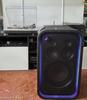
Sony ULT Tower 7 – Hands-On Technical Review
[This review was collected as part of a promotion.] Introduction
I have been testing the Sony ULT Tower 7 both indoors and outdoors, using a variety of music from my own collection and a range of different audio sources. My aim was to assess not only its performance as a high-power party speaker, but also how versatile it is as an everyday music system.
My testing has included music from the 1960s through to the present day, covering rock and roll, rock, heavy metal and other genres. I have also tested Bluetooth playback using a Samsung Galaxy S25 Ultra, Sony Walkman NW-A45, Samsung Galaxy Book Flex Laptop, USB playback from a music-filled USB A drive, and analogue playback from my Technics record player connected through the Line 1 input.
This range of sources gave me the opportunity to assess how the ULT Tower 7 performs with both modern digital sources and traditional analogue music.
Build Quality and Portability
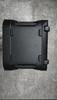
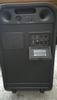
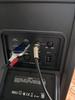
The build quality of the ULT Tower 7 impressed me. Despite its size, it is relatively easy to handle while still feeling solid and well-constructed, with the main controls on the top for ease of access and the connections on the back behind a substantial waterproof cover.
Moving the speaker using the integrated rollers/casters was straightforward, making it easy to reposition around the house or move it outside into the garden. Lifting it using the side handles was also manageable.
There is one area where I think Sony could improve the design. For a taller person, using the grab handle to pull the speaker over a longer distance requires a slight crouching position. A short telescopic handle, similar to the handle on a suitcase, could make longer journeys more comfortable.
This would, in my opinion, be a useful design improvement while retaining the current portability of the speaker.
Setting Up and Connecting the Speaker
Initial connection to the Sony Sound Connect app was smooth and easy to follow. Once connected, the app provided convenient access to a range of the speaker's functions.
I used my Samsung Galaxy S25 Ultra, Sony Walkman NW-A45 and Samsung Galaxy Book Flex Laptop as Bluetooth sources, all playing music from my own collection. I also tested USB playback using a USB A drive containing music.
For me, one of the more interesting tests was connecting my Technics record player to the ULT Tower 7 through the Line 1 input. This demonstrated that the speaker is not restricted to Bluetooth or other modern digital sources.
Digital and Analogue Listening
The difference between the digital and analogue sources was particularly interesting.
When listening through the Technics turntable, I found the sound noticeably crisper and more distinctive than when using the Galaxy S25 Ultra or Walkman NW-A45. The analogue presentation had a different character in my view, with the interaction between the stylus and the vinyl groove producing what I perceived as greater depth and texture in the music. I believe this was partly due to the way the Tower 7 reproduced the characteristics of the analogue source.
I particularly noticed this in the tonal qualities and pitch of instruments and vocals. The vinyl playback gave the music a more natural and engaging character.
This was an important part of my testing because the ULT Tower 7 is primarily presented as a powerful party speaker, yet its Line 1 input also makes it sufficiently versatile for people who enjoy a traditional analogue music source.
ULT Sound Modes
The different ULT settings produced a noticeable change in the way the music was presented.
With the standard ULT setting, vocals remained clear and were more easily heard above the accompanying music. I found this particularly effective with vocal-led tracks where the singer is an important part of the recording.
Switching to the deeper-bass ULT setting changed the character of the music considerably. The increased bass gave the music a greater sense of presence, with the sound moving from what I perceived as being more in the background to becoming more immersive and seemingly surrounding me.
There was, however, a slight reduction in vocal prominence with the deeper-bass setting.
For bass-heavy music, and tracks where overall impact and atmosphere are more important than vocal clarity, I found the deeper-bass setting particularly effective. For vocal-led music, I preferred the standard ULT setting. There are 4 settings available in the sound effect section in the app, they are Flat, ULT 1, ULT 2 and live. Each is customisable in the app with its own Equaliser. I found using Flat and Live retained the music's original sound quality. All were tested at the aps neutral/0 range with no adjustment to the Equaliser. This function will allow users to adapt their music's sound to their own preference from a good, initial pre-set level.
Music Quality and High-Volume Performance
I tested the ULT Tower 7 with music from a wide range of genres and eras, including recordings from the 1960s through to the 1980s, as well as rock and roll, rock and heavy metal.
With the 1960s–80s recordings I tested, the sound quality remained good at low and medium volume levels. When pushing the volume towards the very high levels, I occasionally noticed a small amount of distortion, particularly with recordings featuring synthesised sounds and some of the production characteristics associated with music from that period.
Heavy metal retained its characteristic sound even at high volume, while rock and rock and roll also maintained good clarity and musical character.
Importantly, the slight distortion I experienced only became apparent when the volume was set very high. At normal listening levels, and even at fairly high volumes, I found the overall sound quality remained clear and enjoyable.
Indoor and Outdoor Performance
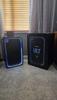
I tested the ULT Tower 7 both indoors and outdoors, including extended listening in the garden.
Indoors, the surrounding walls and other reflective surfaces contributed to the immersive effect of the sound. When I moved the speaker outside, that impression of being completely surrounded by the music was slightly reduced.
This was not a significant loss of sound quality, but rather the natural difference between an enclosed room and an open outdoor environment, where there are fewer surfaces for the sound to reflect from.
What impressed me was the consistency of the sound as I moved around the garden. The audio remained clear when moving around the listening area and when moving further away from the speaker.
I could also maintain control of the speaker through the Sony Sound Connect app while moving around the garden, making it easy to adjust settings without having to return to the speaker. This was also true indoors as I was able to control the Tower 7 from different rooms both upstairs and downstairs.
Sony Sound Connect App
The Sony Sound Connect app was straightforward to connect and easy to follow.
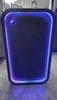
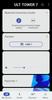
I particularly liked being able to adjust the EQ settings and control the lighting from the app. The lighting controls allow the colour, mode and rate to be adjusted, while the ability to synchronise the lighting with the music adds another dimension to the speaker when used for parties or outdoor entertainment.
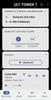
The app also allowed me to connect the ULT Tower 7 with my devices and retain those devices for later connection once paired. This made switching between devices quick and easy once the connection had been established with the app.
Lighting
The lighting functions are easy to control through the app, and I found the different colour, mode and rate settings simple to use.
One limitation I noticed was the lack of a dedicated dimming control. While the lighting can be changed or switched off, I would have liked the ability to reduce the brightness to a level somewhere between full illumination and off.
Sony's instructions acknowledge that the lighting can appear bright or glaring and recommend increasing the room lighting or switching the speaker lighting off.
In my view, incorporating a brightness/dimming control into the app would be a useful future improvement. It would allow users to retain the lighting effect while reducing its intensity to suit the environment.
USB A Playback
I tested USB A playback using a USB A drive containing music from my own collection.
Having tested Bluetooth through both my Galaxy S25 Ultra and Sony Walkman NW-A45, analogue playback via Line 1 through my Technics record player and USB playback, I found the range of available source options particularly useful.
This flexibility means that the ULT Tower 7 can be used in several different ways rather than being restricted to a Bluetooth-only party speaker.
Battery and Charging
I have not yet completely discharged the battery, so I cannot give a definitive real-world figure for total battery life.
Sony quotes up to 30 hours of battery life, depending on usage and settings. During my initial testing, I found that using the lighting effects, particularly when synchronised with the music, appeared to reduce the available operating time compared with using the speaker without the lighting effects.
This is not unexpected, as additional features place an additional demand on the battery. I would need to carry out a complete discharge test to provide a definitive assessment.
Charging seemed relatively quick during the period of my testing. However, I have not yet carried out a complete discharge followed by a full charge cycle, so I have not been able to properly test the speaker's specified fast-charging performance.
Microphone and Instrument Inputs
I have tested the karaoke function, including the four different voice modes: Double Tracking, Munchkin, Mouse and Radio.
By far the effect which brought the most fun to the event was Mouse, as everyone enjoyed the way it stretched their voices slightly, changed them to a soft, high pitch and gave them the comic effect associated with cartoons.
I do not play guitar, so I have not been able to assess the guitar/instrument input. I